Mailer Box Sizes: Standard Dimensions and Size Chart
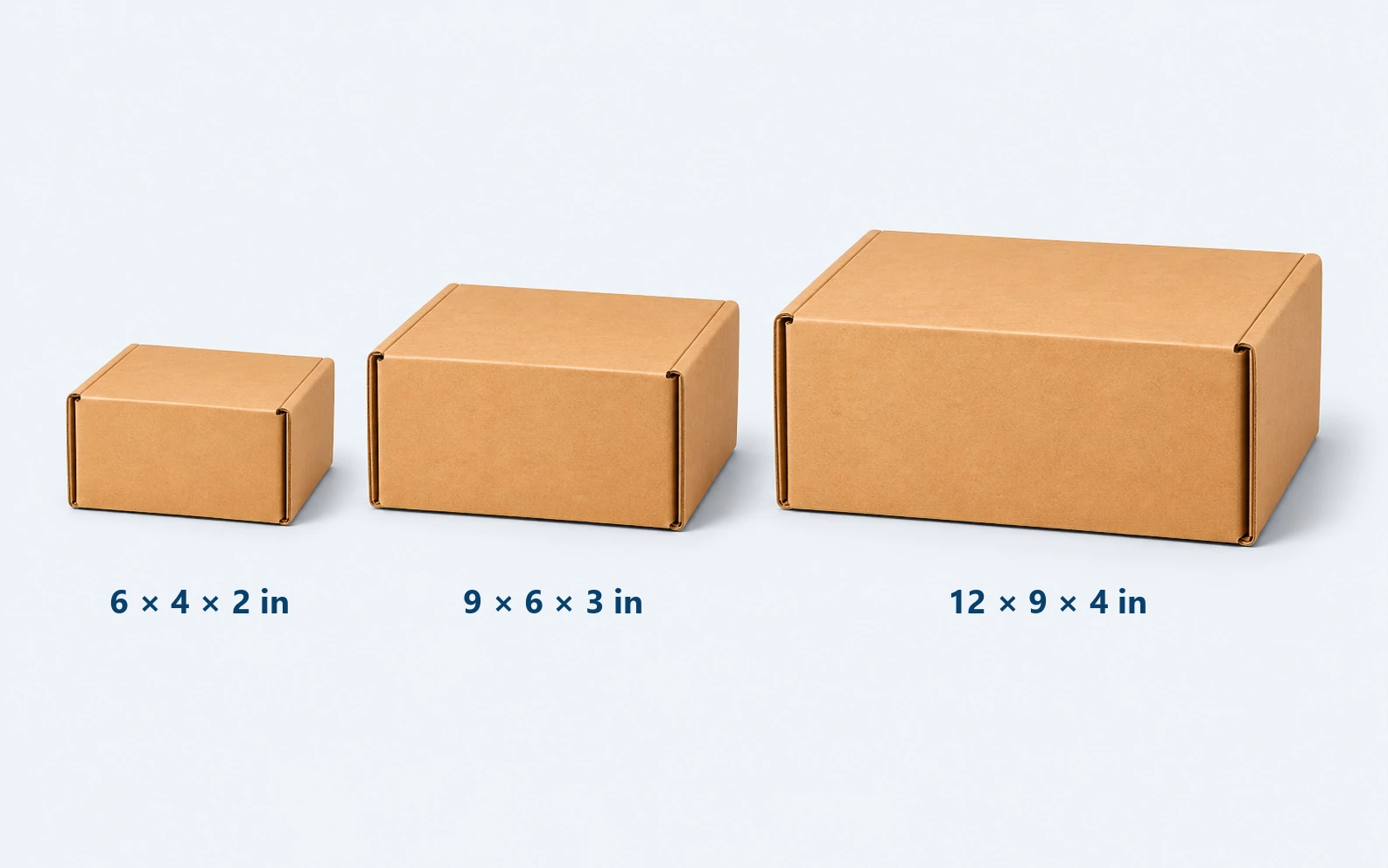
Mailer box sizes are listed as inside length × width × depth, in inches. There is no single official standard, but most brands use a handful of common sizes, such as 6 × 4 × 2, 9 × 6 × 3 and 12 × 9 × 4 inches. The right size fits your product snugly, with no empty space.
A box that’s too big wastes material, lets your product slide around and can raise your shipping bill. A box that’s too small crushes the product or won’t close. This guide explains mailer box dimensions, gives you a simple size chart and shows how to pick the one that fits.
How are mailer box dimensions measured?
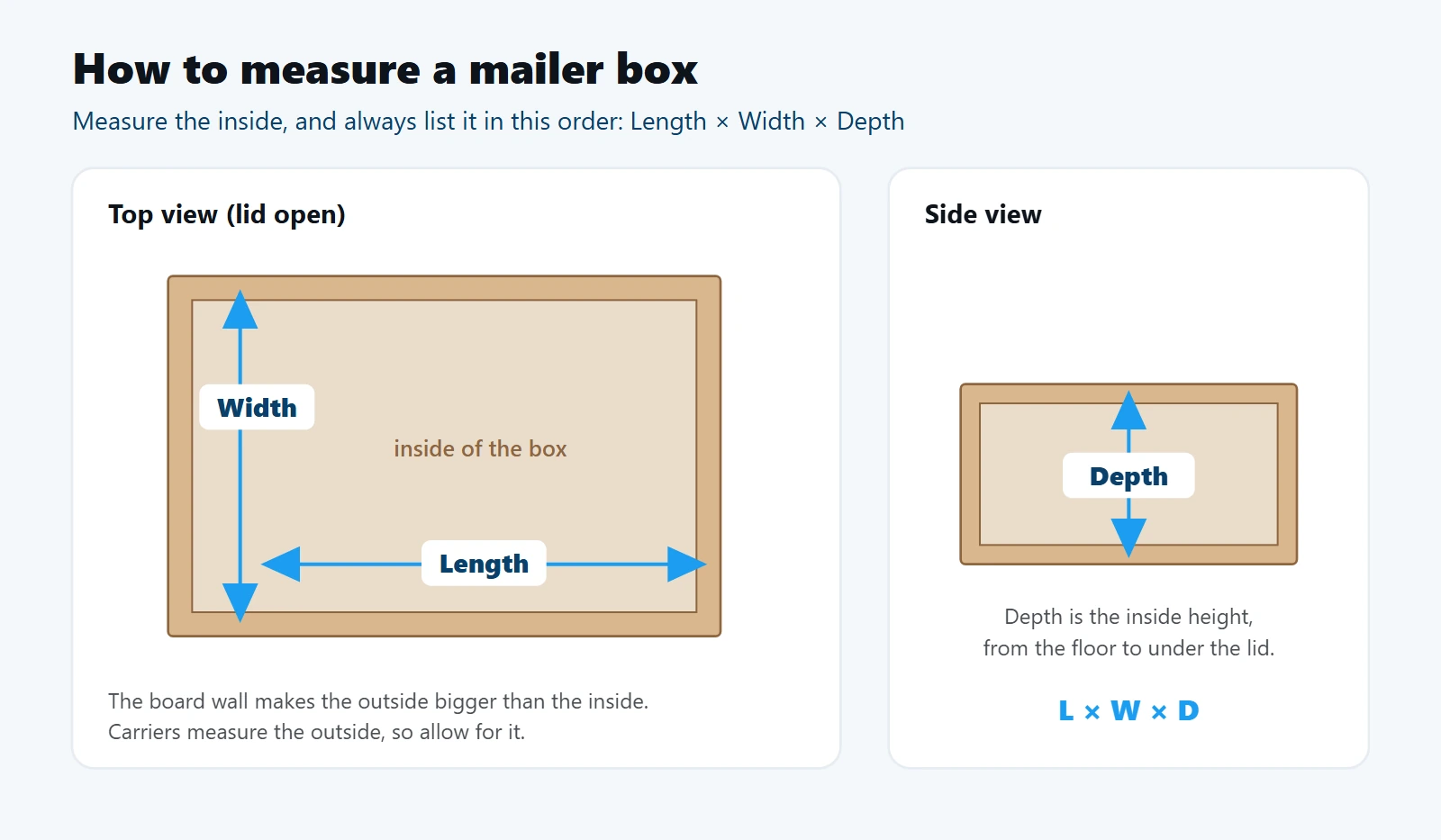
Mailer box dimensions are measured on the inside, in the order length × width × depth. Length is the longer side of the opening. Width is the shorter side. Depth is the inside height, from the floor to the underside of the lid. So a 9 × 6 × 3 mailer is 9 inches long, 6 wide and 3 deep inside.
Here is what each number means:
- Length (L): the longer side of the opening.
- Width (W): the shorter side of the opening.
- Depth (D): the inside height, from the floor to the underside of the lid.
The order matters. A 9 × 6 × 3 box and a 9 × 3 × 6 box are very different shapes.
Are mailer box sizes inside or outside measurements?
Mailer box sizes are usually inside measurements, because that is the space your product needs. The outside is bigger. The board has thickness, and most mailer boxes have rolled side walls that fold over into a double layer. That often adds about 1/8 to 1/4 inch in each direction, depending on the board.
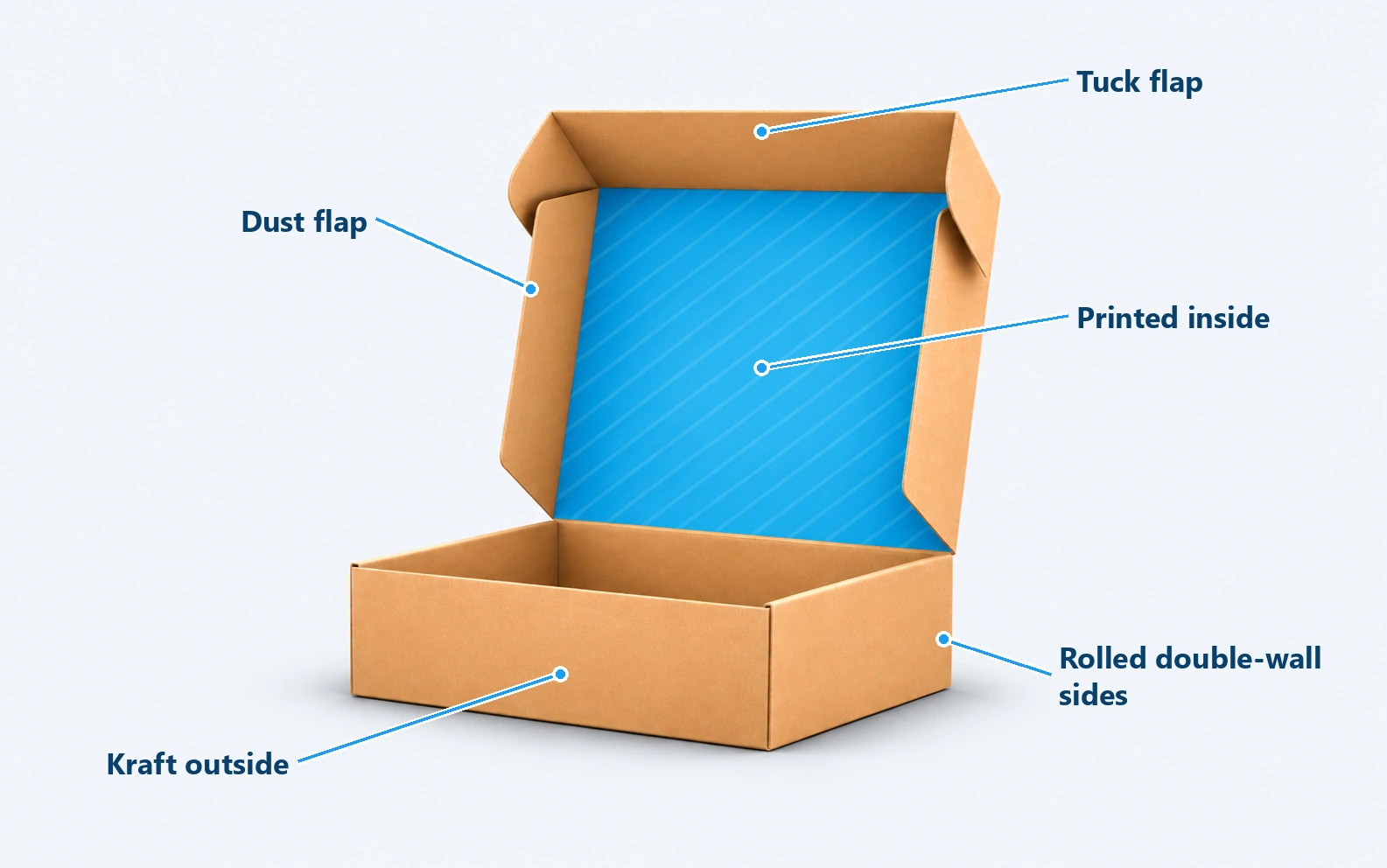
This matters for two reasons. Your product has to fit the inside, but carriers price shipping by the outside. Always check which one a size chart shows before you order.
What are the standard mailer box sizes?
There is no official standard for mailer box sizes. Most brands pick from a set of common inside sizes. Small mailers run from about 4 × 4 × 2 to 8 × 6 × 2 inches. Medium mailers run from about 9 × 6 × 3 to 10 × 8 × 4 inches. Large mailers are around 12 × 9 × 4 inches and up.
Use this mailer box size chart as a starting point:
| Group | Size (L × W × D, inches) | Good for |
|---|---|---|
| Small | 4 × 4 × 2 | Rings, earrings, earbuds, small candles |
| Small | 6 × 4 × 2 | Jewelry sets, lip care, small accessories |
| Small | 8 × 6 × 2 | Skincare sets, phone accessories, socks |
| Medium | 9 × 6 × 3 | Cosmetics kits, small subscription boxes |
| Medium | 10 × 8 × 2 | A single folded T-shirt, notebooks |
| Medium | 10 × 8 × 4 | Subscription boxes, two or three folded items |
| Large | 12 × 9 × 2 | Books, prints, flat apparel. See literature mailer boxes |
| Large | 12 × 9 × 4 | Hoodies, larger kits, multi-item orders |
If your product falls between two sizes, a custom size will fit better than the next size up. Bigger items need bigger boxes. For example, Sorlet’s custom hat mailer box is 35 × 35 × 10 cm (about 13.8 × 13.8 × 3.9 inches), sized to a wide-brimmed hat.
At Packlic, custom mailer boxes are made in sizes from 3 × 3 × 1 inches up to 12 × 9 × 4 inches, or to your own measurements.
What size mailer box do I need?
You need the smallest mailer box your product fits in snugly. Measure the product at its widest points. Add the thickness of any insert. Then add about 1/8 inch (3 mm) of clearance on the length and width. Check the depth so the lid closes flat. Those numbers, written as L × W × D, are your size.
Follow these steps and you’ll get a snug fit the first time.
- Measure the product at its widest points. If it’s already in its own box or pouch, measure that.
- Add the insert. If you use a cardboard insert or tissue, add its thickness to each side.
- Add a small clearance. About 1/8 inch (3 mm) on the length and width is usually enough for a snug fit. Fragile items need a little more room for padding.
- Check the depth. The lid must close flat. If the product sits higher than the walls, the lid will bulge or pop open.
- Write it as L × W × D. These are your inside dimensions.
- Ask for a 3D mockup or sample. Seeing the box before production catches sizing mistakes early. Packlic sends a free 3D mockup in about an hour, and our team prepares the dieline for your exact size.
Tip for small brands: pick two or three sizes that cover most of your orders. Fewer sizes mean simpler reorders, less storage space and a lower price per box, because you order more of each.
What board are mailer boxes made from?
Mailer boxes are made from corrugated board: a wavy layer called the flute, glued between two flat sheets. The two common flutes are E-flute and B-flute. E-flute is about 1.5 mm (1/16 inch) thick and prints crisply. B-flute is about 3 mm (1/8 inch) thick and protects heavier items better.
The flute also changes the outside size. Thicker board adds more to each outside dimension, so a B-flute box is a little bigger outside than an E-flute box with the same inside size.
- E-flute suits cosmetics, apparel, jewelry and most subscription boxes.
- B-flute suits heavier or more fragile products, such as glass jars or kits.
- White or kraft is the outside liner. White gives bright print colors. Kraft has a natural brown look. Packlic makes both in recyclable corrugated mailer boxes.
Board choice can fix a damage problem. When Sorlet’s hats kept arriving crushed, Packlic moved the box onto a heavier flute so it holds its shape in transit.
How does box size change your shipping cost?
Box size changes shipping cost through dimensional weight, or DIM weight. Carriers multiply the outside length × width × height in inches, then divide by a number called the divisor. UPS and FedEx use 139 on standard daily rates. You pay for whichever is higher: the real weight or the dimensional weight.
Here’s how it works:
- Multiply the outside length × width × height in inches.
- Divide by the carrier’s divisor. UPS and FedEx use 139 on their standard daily rates.
- Round up to the next whole pound.
- The carrier charges for whichever is higher: the real weight or the dimensional weight.
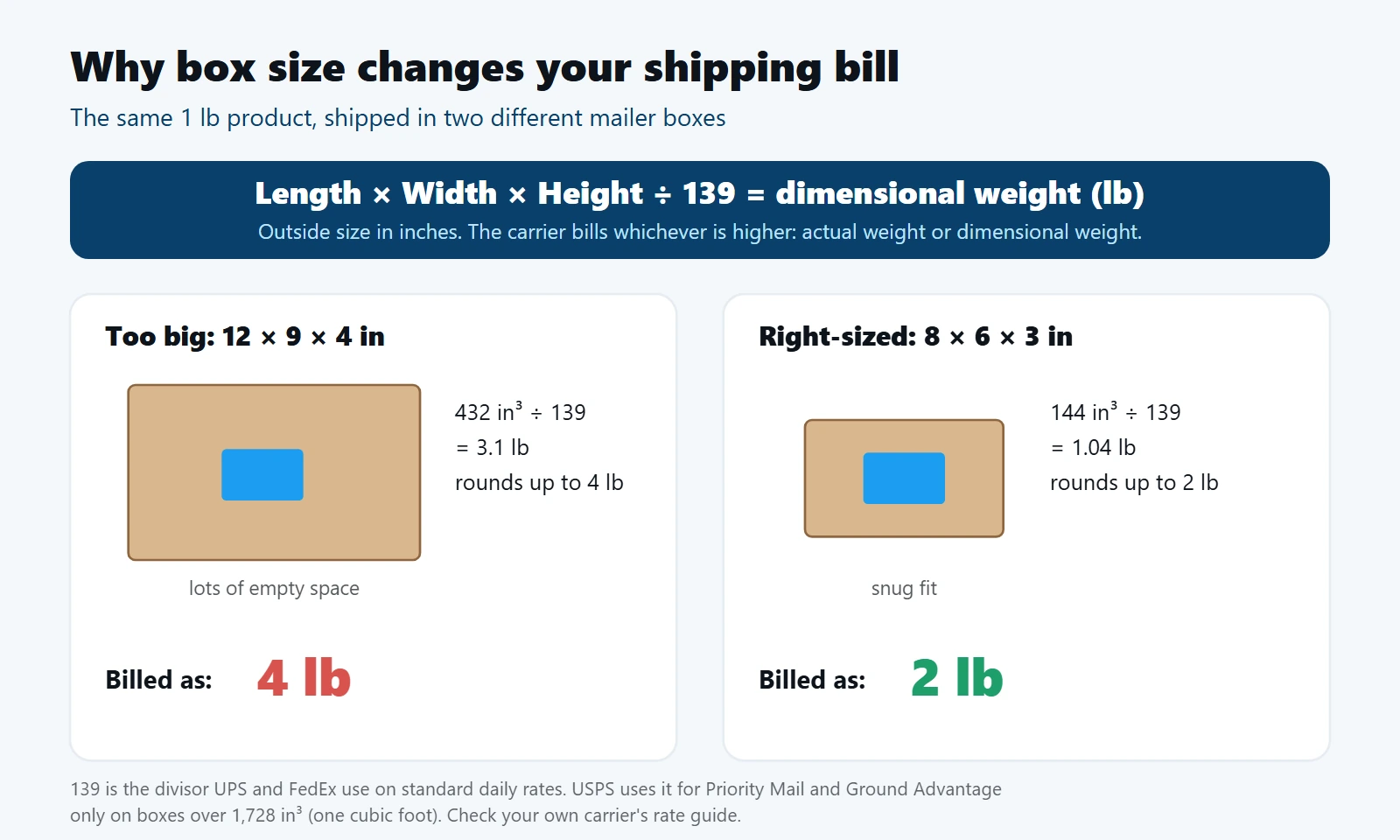
So a 1 lb product in a 12 × 9 × 4 inch box is billed as 4 lb. The same product in an 8 × 6 × 3 inch box is billed as 2 lb. Multiply that across hundreds of orders and the savings are real.
USPS works a little differently. For Priority Mail and USPS Ground Advantage, USPS only applies dimensional weight to packages larger than one cubic foot, which is 1,728 cubic inches. Most mailer boxes are smaller than that. A 12 × 9 × 4 inch mailer is only 432 cubic inches, so with USPS you usually pay by real weight. Check your own carrier’s current rate guide, because divisors can change by service.
Should you use stock or custom mailer box sizes?
Stock mailer boxes come in fixed sizes and are usually sold plain. Custom size mailer boxes are made to your product’s exact measurements. Stock boxes are quick to get and fine for testing. Custom sizes cost a little more to set up, but they fit snugly, print with your brand and often lower shipping costs.
| Stock size | Custom size | |
|---|---|---|
| Fit | Often leaves empty space | Snug, made for your product |
| Printing | Usually plain | Printed inside and out with your brand |
| Shipping cost | Can trigger higher dimensional weight | Smallest box that works |
| Void fill | Often needed | Little or none |
| Best for | Testing, very low volume | Ongoing orders, branded unboxing |
Custom doesn’t have to mean huge orders. Packlic makes custom mailer boxes from 100 units, with production in 7 to 10 days. You can also pick kraft mailer boxes for a natural look, white mailer boxes for bright full-color print, or black mailer boxes for a premium feel. For quick opening, there are mailer boxes with a tear strip.
Want to see a real one? The Crystal & Co mailer box story shows how a Pantone-matched mailer box with a die-cut voucher insert was made for a training package.
What is the difference between a mailer box and a shipping box?
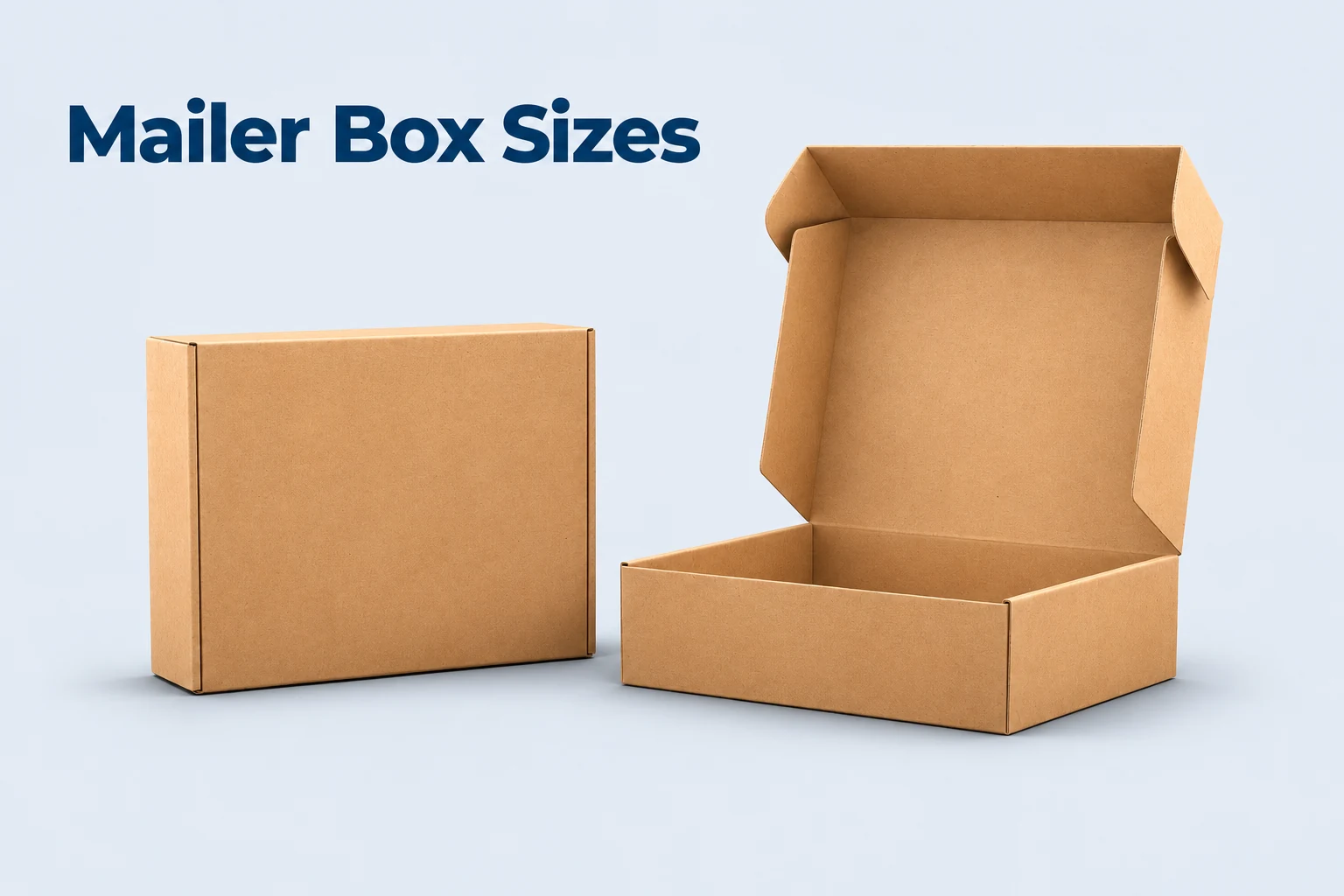
A mailer box is a one-piece corrugated box with fold-in side wings and a front tuck flap. It closes without tape and opens like a gift. A standard shipping box has four flaps on the top and bottom that you tape shut. Mailer boxes suit ecommerce and subscriptions. Shipping boxes suit bulk and heavy goods.
The rolled side walls make a mailer box strong for its size. A shipping box is built for moving goods, not for presentation, and it usually comes in larger sizes. If you want the look of a mailer with more strength for transit, see our mailer shipping boxes.
What are the most common sizing mistakes?
- Measuring the outside instead of the inside. Your product won’t fit, or the box will be too big.
- Mixing up the order. Writing 9 × 3 × 6 when you mean 9 × 6 × 3 gives you a tall, narrow box.
- Forgetting the insert. Inserts and padding take up space too.
- Leaving too much empty space. It wastes board, needs void fill, lets items move and can raise your shipping cost.
- Making it too tight. The lid bulges, the corners split, or the product gets scuffed.
- Too many sizes. Ten different sizes means ten small orders. Two or three well-chosen sizes is easier to manage.
Frequently asked questions
What is the most common mailer box size?
There is no single standard mailer box size. The most widely used inside sizes are 6 × 4 × 2, 8 × 6 × 2, 9 × 6 × 3, 10 × 8 × 4 and 12 × 9 × 4 inches.
Are mailer box sizes inside or outside measurements?
Box makers usually list mailer box sizes as inside measurements, because that’s what your product needs. Carriers measure the outside to work out shipping costs. Always check which one a size chart shows.
How much bigger should a mailer box be than the product?
For a snug fit, a mailer box should be about 1/8 inch (3 mm) bigger than the product on the length and width. Add the thickness of any insert or padding. Fragile items need a little more room.
How do you calculate the cubic size of a mailer box?
Multiply the length × width × height in inches. A 12 × 9 × 4 inch mailer box is 432 cubic inches. Use the outside size when you work out shipping costs.
What size mailer box do I need for a T-shirt?
A single folded T-shirt usually fits a 10 × 8 × 2 inch mailer box. A hoodie, or two or three items, usually needs about 12 × 9 × 4 inches.
Does dimensional weight apply to small mailer boxes?
With UPS and FedEx standard rates, yes, so size matters even for small mailer boxes. With USPS Priority Mail and Ground Advantage, it only applies to packages over one cubic foot, and most mailers are smaller.
What is the smallest custom mailer box Packlic makes?
Packlic makes custom mailer boxes from 3 × 3 × 1 inches. That size suits rings, earbuds and samples.
Can I get a mailer box in my own size?
Yes. Send your product’s measurements and Packlic will size the mailer box to fit, starting from 100 units.
The bottom line
Measure the inside, write it as L × W × D, add a little room for the insert, and pick the smallest box your product fits in snugly. That keeps the product safe, cuts empty space and helps keep shipping costs down. When you’re ready, browse our custom mailer boxes or get a quote with your sizes. Quotes come back within 24 hours.
Sources
- UPS, Shipping Dimensions and Weight: ups.com
- FedEx, What is Dimensional Weight?: fedex.com
- USPS, Parcel Size, Weight & Fee Standards: faq.usps.com